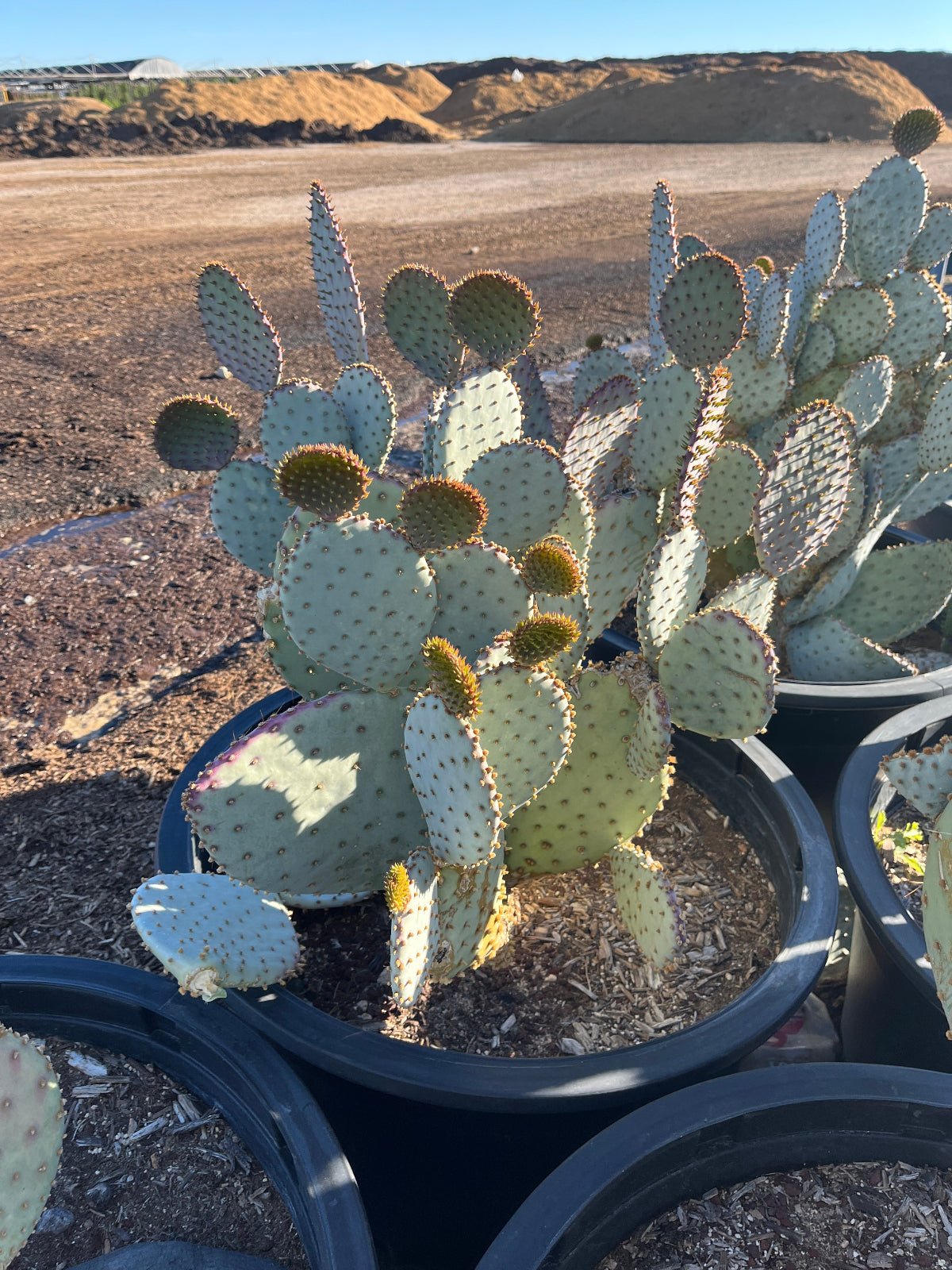
SKU: 17525863571
prickly pear cactus price

prickly pear cactus price Buy Purple Prickly Pear Phoenix, AZ | Opuntia santa-rita

Sale price$25.40 Regular price$28.22
Save 10%

Pay in installments of $7.05 with ShopPay, AfterPay and Klarna

Shipping Estimate
USA
  • USA
  • CAN

Ships within 48 hours · Estimated delivery Nov 11 - Nov 16

Promo Codes Available:

For Your Every Summer RSVP, with Code: SUMMER15

Description

prickly pear cactus price Buy Purple Prickly Pear Phoenix, AZ | Opuntia santa-ritaArizona's Most Colorful Native Cactus Purple Pads Year Round The Purple Prickly Pear (Opuntia santa rita) is the showstopper of the prickly pear family and one of the most eye catching native cacti you can plant in a Phoenix landscape. Its broad, flat pads shift from blue green to deep purple under cold or drought stress meaning you get stunning color exactly when your garden needs it most. Growing just 23 feet tall and spreading 35 feet wide, this

Arizona's Most Colorful Native Cactus — Purple Pads Year-Round

The Purple Prickly Pear (Opuntia santa-rita) is the showstopper of the prickly pear family and one of the most eye-catching native cacti you can plant in a Phoenix landscape. Its broad, flat pads shift from blue-green to deep purple under cold or drought stress — meaning you get stunning color exactly when your garden needs it most. Growing just 2–3 feet tall and spreading 3–5 feet wide, this low-growing cactus produces showy yellow flowers with red-orange centers in spring, followed by edible reddish-purple fruit. Whether you're building a drought-tolerant front yard in Scottsdale, filling a rocky slope in Fountain Hills, or creating a native cactus garden in Mesa — Purple Prickly Pear delivers year-round color with zero irrigation once established.

Purple Prickly Pear Plant Details

Attribute Detail
Scientific Name Opuntia santa-rita
Common Names Purple Prickly Pear, Santa Rita Prickly Pear, Violet Prickly Pear
Mature Height 2–3 feet
Mature Width 3–5 feet (spreading)
Growth Rate Moderate — fills in within 1–2 years in Phoenix
Sun Full sun (6+ hrs). Handles reflected heat from walls and pavement.
Water Extremely low once established. Thrives on rainfall alone in Phoenix.
USDA Zones 8–11 (Phoenix is Zone 9b–10a)
Soil Well-draining. Adapts to Arizona caliche and rocky native soils.
Foliage Evergreen — pads stay year-round, turn purple in cold/drought
Native Status Native to Arizona, southern New Mexico, and northern Mexico

Purple Prickly Pear Uses in Phoenix Landscapes

Drought-Tolerant Front Yard & Xeriscape

Purple Prickly Pear is the ultimate zero-water landscape plant once established. Mass-plant 3–5 specimens across a gravel or decomposed granite bed for a colorful, maintenance-free front yard. The purple pads pop against warm-toned gravel — a look that's become a signature of modern Scottsdale and Gilbert xeriscapes. Pair with Golden Barrel Cactus and Desert Spoon for texture contrast.

Native Cactus Garden

Create an authentic Sonoran Desert garden by grouping Purple Prickly Pear with Engleman's Prickly Pear, Mexican Fence Post, and Totem Pole cactus. The color contrast between the purple pads and the green columnar cacti creates a striking display. This combination thrives in Tempe, Chandler, and Mesa with almost no supplemental water.

Slope & Erosion Control

The spreading growth habit and dense root system make Purple Prickly Pear an excellent choice for stabilizing slopes and hillsides in Fountain Hills, Cave Creek, and north Scottsdale. Plant 3 feet apart on slopes — the pads will knit together within 2 seasons to create a colorful, erosion-resistant groundcover.

Wildlife & Pollinator Garden

The spring flowers attract native bees and butterflies, while the edible fruit feeds birds and desert wildlife through summer. Plant near a patio or window in Peoria or Glendale for front-row wildlife viewing.

Best Time to Plant Purple Prickly Pear in Phoenix

Fall (October–November) is ideal — warm soil encourages root growth while cooler air reduces transplant stress. This gives your prickly pear 6–8 months of root establishment before its first Phoenix summer. Spring (February–April) is the second-best window. Avoid planting in peak summer if possible, though established Purple Prickly Pear is incredibly heat-tolerant.

How to Plant Purple Prickly Pear

  1. Dig wide, not deep — 2–3x the root ball width, same depth as the container.
  2. Check for caliche — break through any hardpan layer for drainage. Prickly pear will rot in standing water.
  3. Backfill with native soil — no amendments needed. This cactus prefers lean, rocky soil.
  4. Spacing — 3 feet apart for mass planting or slope coverage; 4–5 feet for individual specimens.
  5. Water basin — build a shallow ring to direct water to roots during establishment only.
  6. Mulch — 2–3 inches of gravel or decomposed granite. Never use organic mulch against cacti.

Watering Purple Prickly Pear in Phoenix

First Year Watering Schedule

Weeks 1–2: Every 3–4 days, deep and slow. Month 1–2: Every 7–10 days. Month 3–6: Every 2 weeks. After Year 1: Rainfall only in most Phoenix locations. Supplement once monthly in peak summer only if pads look shriveled.

Drip Irrigation

Place one 1 GPH emitter 12 inches from the base during the first year. After establishment, remove or turn off supplemental irrigation — overwatering is the #1 killer of prickly pear in Phoenix landscapes.

How fast does Purple Prickly Pear grow in Phoenix?
Moderate growth — a 1-gallon plant will fill a 3–4 foot area within 2 years in full sun. New pads emerge in spring and summer, each one adding to the spreading clump.

Why do the pads turn purple?
The purple coloring intensifies during cold weather (winter) and drought stress. It's caused by anthocyanin pigments — the same compounds that make blueberries blue. The more stress, the deeper the purple. In summer with regular water, pads shift back toward blue-green.

Is Purple Prickly Pear fruit edible?
Yes! The reddish-purple fruit (called tunas) is edible and has been used in traditional Southwestern cuisine for centuries. Harvest with tongs in late summer — they make excellent jams, syrups, and agua fresca.

Does Purple Prickly Pear have spines?
Purple Prickly Pear has fewer spines than most prickly pear species, but it does have glochids (tiny hair-like barbs). Plant it at least 3 feet from walkways and play areas. Use leather gloves when handling.

Can Purple Prickly Pear handle Phoenix summer heat?
Absolutely — it's native to the Sonoran Desert and handles temperatures well above 115°F. It also tolerates reflected heat from walls, concrete, and asphalt without any issues.

You May Also Like

Engleman's Prickly Pear — Arizona's classic green prickly pear, perfect for pairing with Purple Prickly Pear for a two-tone cactus display.
Golden Barrel Cactus — A round, golden-spined cactus that contrasts beautifully with the flat purple pads.
Mexican Fence Post — A tall columnar cactus that adds vertical height behind low-growing prickly pear.
Queen Victoria Agave — A compact, geometric agave with white markings — stunning accent next to purple pads.
Totem Pole Major — A smooth, spineless columnar cactus that pairs perfectly in modern desert gardens.

How Many Purple Prickly Pear Do I Need?

This is a low, spreading cactus (3 to 5 ft wide) that knits together for slope cover, mass plantings, and erosion control. Space plants about 3 ft on center to fill in within two seasons. Use the coverage table to plan a bed or slope:

Area to Cover Plants at 3 ft Centers
50 sq ft 5–6
100 sq ft 11–12
200 sq ft 22–24

For a single color accent in a gravel bed, one plant reads beautifully. Keep all plantings at least 3 ft back from walkways and play areas, since the pads carry glochids.

Purple Prickly Pear Season-by-Season in Phoenix

  • Spring (Feb–Apr): Showy yellow flowers with red-orange centers open along the pad edges, drawing native bees and butterflies. New pads flush as the weather warms. Strong second planting window.
  • Summer (May–Sep): Shrugs off temperatures well above 115°F and reflected heat on rainfall alone. Edible reddish-purple tunas ripen by late summer. Keep soil dry between any supplemental soaks.
  • Fall (Oct–Nov): Prime planting season. Warm soil and mild air give roots months to establish.
  • Winter (Dec–Jan): Cold and drought stress deepen the pads to vivid purple, the plant's signature look. Very cold hardy to about 15°F, so it sails through Valley winters with no protection.

At a Glance

✔ Arizona Native   ✔ Heat-Loving (Reflected-Heat Tolerant)   ✔ Drought-Tolerant   ✔ Pollinator-Friendly   ✔ Edible   ✔ Evergreen   ✔ Low-Maintenance   ✔ Fire-Wise   ✔ Deer & Rabbit-Resistant   ✔ Cold-Hardy to 15°F

Plant It With

  • Engleman's Prickly Pear: Arizona's green native prickly pear for a two-tone pad display.
  • Mexican Fence Post: tall columns that add vertical height behind the low purple pads.
  • Totem Pole Major: a smooth sculptural column that pairs cleanly in a modern desert bed.
  • Desert Spoon: a silvery rosette that adds soft texture contrast to the flat pads.

Is Purple Prickly Pear Right for Your Yard?

It thrives in full sun and reflected heat in lean, fast-draining native soil, making it a no-irrigation choice for front yards, slopes, and native cactus gardens. Break through caliche so water never stands at the roots. It is not a fit right beside walkways, patios, or play areas, since the glochids catch skin and clothing: give it at least 3 ft of clearance.

Shipping Notes
  • Free Standard Shipping on $100+ Orders to the USA.
  • Except Preorder products are shipped in 48 hours.
  • Delivery to the USA:
  1. Standard Shipping : 3-10 business days
  • If time is of the essence, please consider selecting expedited delivery for faster service.
Exchange/Return Notes
  • We offer a 30-day return/exchange service after receiving.
  • Final sale items are not eligible for returns or exchanges.
  • To process your return/exchange, please contact us at [email protected]
  • Please click here for more details>>> Return & Exchange Policy
SKU: 17525863571

Discover Niche Categories That Outsell prickly pear cactus price

Top-Converting Item to Boost Your Average Order

4.6 ★★★★★
Based on 15 reviews
Sort
Highest Rating
Newest First
Oldest First
Product Reviews
P
Verified Purchase
Public user
Alexandria, US
★★★★★ 5
The same convoluted / painful User Experience as existed in the 1980s
I hadn't purchased something like this since college so I assumed it would be a radically different UX (user experience) regarding setup / functionality. Nope. Getting the device to actually play the audio I'm hoping / attempting to play is a constant battle. (Certainly partially due to my incompetence and also the horrible projector software I'm using (BenQ - atrocious software). I'm sure after I've owned the Yamaha for 5-10 years I'll get the hang of it but it would certainly be nice if these incredible systems could communicate w/ one another (i.e. "hey, there's a signal coming in from Device X - I think I'll hide all dormant inputs so it's less confusing..." Annnyway, the sound is absolutely fantastic. I'm thrilled w/ the quality of sound every time we use it. After my anger fades because I just spent 20-30 minutes trying to get sound to output for the movie / game / show we're attempting to watch. Yes, I'm a grumpy old man. You will be too one day.
WAS THIS REVIEW HELPFUL?YesReportShare
Reviewed in the United States on June 21, 2023
S
Verified Purchase
Sparkie
West Palm Beach, US
★★★★★ 4
Mostly Satisfied, but a little let down!
I am upgrading from a Yamaha RXA-870 which is still a great amp and I love it, but wanted the ATMOS with 11.2 surround... The RXA-870 has a far superior Web App to where you can control so much ore. The A8A has a lot of control, but seems to be missing the Web App to better control the Surround Sound, The A8A seems to be more automated... I am also having issues where when I calibrate the speakers it continually gives me a message that there is a wiring problem with my Right Speaker, but nothing is wrong with the Right Speaker... When they say that it take 45 Minutes to update the software... They are not lying.. Downloaded to USB and Updated via USB... and it took 45 Minutes... It was flawless, but not as fast as I was hoping. When they say this unit is heavy... they were being 100% truthful... I had to get a neighbors help to set it on the shelf that I wanted it on.. and if you put it on a shelf... IT HAD BETTER BE HEAVY DUTY! -
WAS THIS REVIEW HELPFUL?YesReportShare
Reviewed in the United States on August 27, 2024
S
Verified Purchase
sound freak
Cuba, US
★★★★★ 5
Yamaha A8A
I upgraded from a Onkyo 6100 to support 4 atmos in ceiling speakers. This avr has many more options and power to spare. I love the ability to log in the reciever using the IP address to make all my adjustments. I am able to use a laptop at the listening position to fine tune the sound to my taste. The sound quality has a natural feel to it. It is not too bright on or boomy. I would highly recommend this avr. Pros Sound quality Flexible Plenty of power YPAO room correction finally works as it should. Cons It does put off some heat but that is typical with class AB amps.
WAS THIS REVIEW HELPFUL?YesReportShare
Reviewed in the United States on July 5, 2023
A
Verified Purchase
Amazon Customer
Houston, US
★★★★★ 5
Great AV Features!
I have always been a Yamaha customer for AV and audio components. I always thought their quality is exceptional for the price of the units. For this AVR I first bought the Marantz SR-7015 and set it up only to find a problem with the audio cutting out randomly. I found there were some review posts about this anomaly. I bought the Marantz because it cost less than the Yamaha RX-A8A with similar features and it was available at a retail store. I returned it and purchased this unit through Amazon. I love it! Easy to setup. The menu system is so much easier than the Marantz. I recommend it for those who want to spend a little more for quality. Note: HDMI CEC is an issue with this unit and others so don't hold it against Yamaha. Streaming systems (like Roku) don't work well because their output is always on and the RX-A8A sees the signal and sometime switches to it automatically when video passthrough is enabled when the system is off. Other devices included. That is I have a Sony Ultra HD BD/DVD player and I needed to turn off HDMI CEC because it would always turn on when I turned on the TV and it was selected as the input. Even though my STB was on and the last input. My STB does not support HDMI CEC so that is why the input switched. Again, not an issue with Yamaha but on the standard.
WAS THIS REVIEW HELPFUL?YesReportShare
Reviewed in the United States on June 27, 2022
S
Verified Purchase
SC
Charlottesville, US
★★★★★ 5
Upgrading Home Theater to 4K, SONY STR-AN1000 7 has Awesome Surround Sound and Stunning Pictures
After many years of enjoying my Epson 2150 Home Cinema and my SONY STR-DN1080, I decided to upgrade to a 4K projector. I use my projector as a television, to watch movies, sports, etc., on a daily basis. Upgrading to a 4K projector required me ass well to upgrade my home theatre receiver to 4K. Both of my previous devices were 1080. I upgraded my receiver to a Sony STR-AN1000 7.2 Channel (7 x 165 Watt) Surround Sound Home Theater 8K A/V Receiver and my projector to a LG CineBeam UHD 4K projector. Immediately upon connecting my new 4K devices, I experienced difficulties. The picture was jumpy and intermittent, and I could not seamlessly switch from one input on my new home theater to another. Before the upgrade, I would regularly switch among all of my playback and streaming devices. I started panicking thinking I would have to return all of my new equipment, reconnect my old home theater receiver, and put my old projector back into the ceiling. I decided to call customer support. First, I called LG support. Then I called SONY support. The SONY tech support figured out that the SONY equipment was working properly, but that the LG projector was not receiving the signals from my various devices. He told me the problem was that I needed also to upgrade my HDMI cable to a high-speed 4k cable. That immediately freaked me out because I have a 100 ft cable embedded in a ceiling that had been finished over the cable. No way I was going to rip apart the ceiling (thousands of dollars) to replace the HDMI cable. But his insight set me in the right direction. I did some online research and came across a solution that worked perfectly. Rather than tearing up my ceiling to install a new, high-speed HDMI 4K cable, I invested $39.00 in a HDMI 2.0 Repeater. This super mini HDMI repeater works by decoding and then re-encoding the HDMI signal to a new standard HDMI signal. It also extends the range of the signal. I was now getting perfect pictures from my Firestick and Fite TV Cube and was able to switch freely between them. I changed some of the display settings in the Fire Stick and Amazon Cube. However, I could not pick up the Xfinity TV signal on my LG 4K receiver. Picking up that signal required one last piece of equipment upgrade. I called Comcast technical support and determined that swapping out my Xfinity 1080 boxes for 4K boxes was an option available to me. Therefore, I returned my Xfinity 1080 cable box and swapped it out for an Xfinity 4K cable TV box. Problem solved. Now, I am receiving a perfect 4K image on the LG from all devices, and I can easily switch from one to the other. Now, let's talk about the SONY STR-AN1000 features. SONY STR-AN1000 This is a powerful and well-engineered home theater receiver. For me, the only reason to buy this receiver at this point in time was to upgrade my TV/ home theater watching from 1080 to 4K. My SONY 1080 still works fine. I have to figure out what I am going to do with it. The surround sound is awesome on the new STR-AN1000. It has this new Dolby Speaker Virtualization sound field simulation that totally immerses you in surround sound. You can control the SONY STR-AN1000 with your smartphone using the SONY Music Center App. There are plenty of digital and music streaming options. You have multi-room audio and video options using zone 2 and zone 3 outputs. Six HDMI inputs allow you to connect all of your media playback and streaming devices – Blue Ray player, Fire Stick, Fire TV Cube, ROKU Streaming stick, Cable/satellite TV Box, etc. Like my previous STR-DN1080, I can connect 7 speaker sets, including 2 sub-woofers. You can change the settings or switch from one input source to another easily. The on-screen display lets you make adjustments to your settings while looking at your TV screen. You can connect to the internet wirelessly or via an ethernet port. The only major feature this receiver is lacking is a phono input. I don’t mind that because I have another receiver from which to connect my turntables or record players. The remote control is much smaller than previous SONY home theater receiver remotes, making it more user-friendly and easier to understand. The Audio Return Channel (ARC and eARC) allows you to set your system up without the need for an optical audio cable. In my case, that means I don’t have to run an extra cable into the ceiling for the audio to work because the ARC and eARC transmit the audio signal. This receiver is capable of upscaling your video to both 4K and 8K. However, in my case, I found it necessary to get an Xfinity 4K cable box to watch my Xfinity programming. I am totally, 100 percent pleased with my SONY STR-AN1000 4K/8K home theater receiver. This is the fourth SONY home theater receiver I have owned. I have no complaints. The picture quality passed through from all of my playback devices to my LG 4K projector is stunning. There are so many other features to this receiver; however, those are best explained by an audio/video expert. There are many such reviews available online. But if you are a layperson like I am and you want to know whether this STR-AN1000 home theater is a good investment, my answer, based on a few weeks of viewing and my over a decade of experience with other home theater receivers, is that this is a very good investment. The quality and features you are getting are well worth the purchase price, and I am confident you will be watching a TV or projector hooked up to this home theater system for many years to come. I highly recommend it.
WAS THIS REVIEW HELPFUL?YesReportShare
Reviewed in the United States on March 6, 2024

recommand products