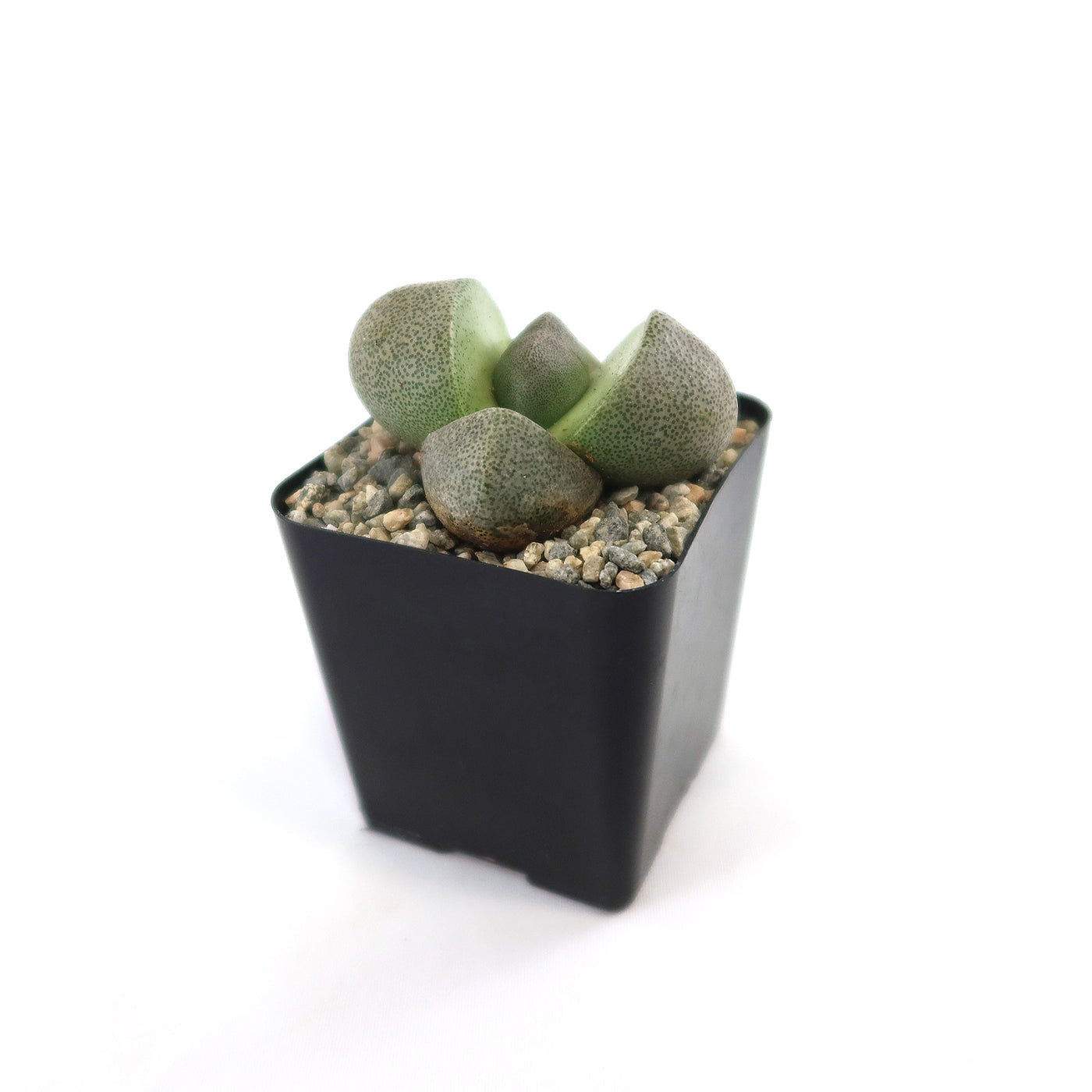
SKU: 41741904044
split rock succulent rotting

split rock succulent rotting Split Rock Succulent 'Pleiospilos nelii' mesembs - Fast Delivery

Sale price$21.20 Regular price$23.56
Save 10%

Pay in installments of $5.89 with ShopPay, AfterPay and Klarna

Shipping Estimate
USA
  • USA
  • CAN

Ships within 48 hours · Estimated delivery Nov 11 - Nov 16

Promo Codes Available:

For Your Every Summer RSVP, with Code: SUMMER15

Description

split rock succulent rotting Split Rock Succulent 'Pleiospilos nelii' mesembs - Fast DeliveryThe split rock succulent, known as Pleiospilos nelii mesembs, is an absolutely stunning succulent plant that belongs to the Mesembryanthemaceae family! "Mesembs" is a common term used to refer to plants in this family, which includes various succulents known for their unique adaptations to arid environments. The split rock succulent has several other common names, such as mimicry plant, cleft stone, or living rock cactus. It gets its name because its

The split rock succulent, known as Pleiospilos nelii mesembs, is an absolutely stunning succulent plant that belongs to the Mesembryanthemaceae family! "Mesembs" is a common term used to refer to plants in this family, which includes various succulents known for their unique adaptations to arid environments. The split rock succulent has several other common names, such as mimicry plant, cleft stone, or living rock cactus. It gets its name because its leaves split open, revealing a cleft in the center. It looks like a rock that has been split in half! 

The split rock plant and Lithops are often confused because of their striking similarities. The biggest distinction between the two is in how they blossom. Both plants bloom in the early fall, but Split Rocks produce multiple flowers in a single reproductive cycle, whereas Lithops only produces one flower at a time. The split rock succulent produces daisy-like flowers in a variety of colors, including orange, white, yellow, and magenta.

Native to South Africa, this egg-shaped succulent has two gray-green, thick, fleshy leaves that cleft down the center. New leaves grow at right angles to the split. It can typically grow up to 4 inches tall and 8 inches wide. This split rock plant also comes in the lovely Pleiospilos nelii "Royal flush" variety, which has deep purple to reddish foliage. 

In terms of propagation, split rock plants can be propagated through seeds or by dividing the offsets that grow from the base of the parent plant. Additionally, this split rock is a friendly plant for both humans and pets, making it a popular choice among plant enthusiasts. 

Watering Needs

When it comes to watering split rock succulents, it's important to remember that they have lower water needs than other succulents. These rock plants are adapted to arid environments, so they prefer infrequent watering. It's best to allow the soil to dry out completely between waterings to prevent overwatering, which can lead to root rot or bursting your concrete leaf plant. 

One helpful tip is to use the "soak and dry" method. This means thoroughly watering your split rock plant until water drains out of the bottom of the pot through drainage holes, and then waiting for the soil to dry out completely before watering again. This helps mimic the natural rainfall patterns these succulents are accustomed to. Remember, it's always better to go underwater than to overwater when it comes to split rock succulents! 

In addition to monitoring the soil moisture, it's also important to consider the environmental conditions. During the active growing season, which is typically spring and summer, split rock succulents may require more frequent watering. However, during the dormant period in fall and winter, they require less water. 

Remember, a healthy Split Rock typically has two sets of leaves. If it develops more than two sets or shows cracking on its epidermis, it's time to stop watering. Avoid watering for at least a week if you notice these signs. 

Light Requirements

When it comes to light requirements, split rock succulents thrive in partial shade to full sun. They prefer a sunny spot where they can receive ample sunlight, but it's important to protect them from intense, direct sunlight, especially during the hottest parts of the day. 

A great location for split rock succulents is near a south or east-facing window, where they can receive bright, filtered light throughout the day. Consider purchasing grow lights if your Split Rock can't get enough light from a south-facing window or any other location.  These can provide the necessary light intensity and duration for healthy growth. Just make sure to position the lights at an appropriate distance from the plants to avoid burning or overheating. 

Remember, each plant is unique, so it's important to observe your split rock succulents and adjust the lighting conditions accordingly.

Optimal Soil & Fertilizer Needs 

When it comes to soil and fertilizer needs, split rock plants prefer a well-drained soil mix specifically formulated for succulents. This type of soil allows excess water to flow out easily, preventing root rot. You can find pre-made succulent soil mixes at your local garden center, or you can create your own by combining equal parts of potting soil, perlite, and coarse sand.

Here at Planet Desert, we have a specialty-formulated succulent potting mix that contains 5 natural substrates and organic mycorrhizae to promote the development of a strong root system that helps your succulent to thrive.  

As for fertilizing, Pleiospilos nelii split rock succulents have low nutrient requirements. It's best to use a balanced natural NPK fertilizer specifically formulated for succulents, and only apply once a year during the active growing season, which is typically early spring. Remember, it's better to under-fertilize than to over-fertilize, as excessive nutrients can harm these plants. 

In general, it's important to avoid overfeeding split rock succulents, as they are adapted to nutrient-poor environments. Too much fertilizer can lead to weak growth and other problems. Always monitor the health and growth of your plants and adjust the fertilization routine as needed. If the leaves start turning yellow or the rock plant appears stressed, it may be a sign of nutrient imbalance or over-fertilization. 

Hardiness Zone & More

Split rock succulents are typically indoor plants and generally hardy in USDA hardiness zones 9 to 11. They thrive in warm climates and can tolerate temperatures ranging from 50°F to 85°F. If you live in a region with extreme temperatures or higher humidity levels, you can still grow split rock succulents indoors or in a controlled environment, such as a greenhouse or terrarium, where you can maintain the ideal conditions for their growth. Just remember to monitor the temperature and humidity levels to ensure they stay within the recommended range. 

In terms of humidity, the rock plants are adapted to arid conditions and prefer low to moderate humidity levels. They can tolerate dry air and do not require high levels of humidity. In fact, excessive humidity can increase the risk of fungal diseases and rot. It's best to provide good air circulation around the split rock to prevent moisture buildup. 

Don't miss out on adding the Pleiospilos nelii - Split rock succulent to your garden! Order now and enjoy its beauty for years to come. 

Shipping Notes
  • Free Standard Shipping on $100+ Orders to the USA.
  • Except Preorder products are shipped in 48 hours.
  • Delivery to the USA:
  1. Standard Shipping : 3-10 business days
  • If time is of the essence, please consider selecting expedited delivery for faster service.
Exchange/Return Notes
  • We offer a 30-day return/exchange service after receiving.
  • Final sale items are not eligible for returns or exchanges.
  • To process your return/exchange, please contact us at [email protected]
  • Please click here for more details>>> Return & Exchange Policy
SKU: 41741904044

Discover Niche Categories That Outsell split rock succulent rotting

Top-Converting Item to Boost Your Average Order

4.3 ★★★★★
Based on 30 reviews
Sort
Highest Rating
Newest First
Oldest First
Product Reviews
P
Verified Purchase
Public user
Port Orchard, US
★★★★★ 5
The same convoluted / painful User Experience as existed in the 1980s
I hadn't purchased something like this since college so I assumed it would be a radically different UX (user experience) regarding setup / functionality. Nope. Getting the device to actually play the audio I'm hoping / attempting to play is a constant battle. (Certainly partially due to my incompetence and also the horrible projector software I'm using (BenQ - atrocious software). I'm sure after I've owned the Yamaha for 5-10 years I'll get the hang of it but it would certainly be nice if these incredible systems could communicate w/ one another (i.e. "hey, there's a signal coming in from Device X - I think I'll hide all dormant inputs so it's less confusing..." Annnyway, the sound is absolutely fantastic. I'm thrilled w/ the quality of sound every time we use it. After my anger fades because I just spent 20-30 minutes trying to get sound to output for the movie / game / show we're attempting to watch. Yes, I'm a grumpy old man. You will be too one day.
WAS THIS REVIEW HELPFUL?YesReportShare
Reviewed in the United States on June 21, 2023
S
Verified Purchase
Sparkie
Birmingham, US
★★★★★ 4
Mostly Satisfied, but a little let down!
I am upgrading from a Yamaha RXA-870 which is still a great amp and I love it, but wanted the ATMOS with 11.2 surround... The RXA-870 has a far superior Web App to where you can control so much ore. The A8A has a lot of control, but seems to be missing the Web App to better control the Surround Sound, The A8A seems to be more automated... I am also having issues where when I calibrate the speakers it continually gives me a message that there is a wiring problem with my Right Speaker, but nothing is wrong with the Right Speaker... When they say that it take 45 Minutes to update the software... They are not lying.. Downloaded to USB and Updated via USB... and it took 45 Minutes... It was flawless, but not as fast as I was hoping. When they say this unit is heavy... they were being 100% truthful... I had to get a neighbors help to set it on the shelf that I wanted it on.. and if you put it on a shelf... IT HAD BETTER BE HEAVY DUTY! -
WAS THIS REVIEW HELPFUL?YesReportShare
Reviewed in the United States on August 27, 2024
S
Verified Purchase
sound freak
Massapequa, US
★★★★★ 5
Yamaha A8A
I upgraded from a Onkyo 6100 to support 4 atmos in ceiling speakers. This avr has many more options and power to spare. I love the ability to log in the reciever using the IP address to make all my adjustments. I am able to use a laptop at the listening position to fine tune the sound to my taste. The sound quality has a natural feel to it. It is not too bright on or boomy. I would highly recommend this avr. Pros Sound quality Flexible Plenty of power YPAO room correction finally works as it should. Cons It does put off some heat but that is typical with class AB amps.
WAS THIS REVIEW HELPFUL?YesReportShare
Reviewed in the United States on July 5, 2023
A
Verified Purchase
Amazon Customer
West Palm Beach, US
★★★★★ 5
Great AV Features!
I have always been a Yamaha customer for AV and audio components. I always thought their quality is exceptional for the price of the units. For this AVR I first bought the Marantz SR-7015 and set it up only to find a problem with the audio cutting out randomly. I found there were some review posts about this anomaly. I bought the Marantz because it cost less than the Yamaha RX-A8A with similar features and it was available at a retail store. I returned it and purchased this unit through Amazon. I love it! Easy to setup. The menu system is so much easier than the Marantz. I recommend it for those who want to spend a little more for quality. Note: HDMI CEC is an issue with this unit and others so don't hold it against Yamaha. Streaming systems (like Roku) don't work well because their output is always on and the RX-A8A sees the signal and sometime switches to it automatically when video passthrough is enabled when the system is off. Other devices included. That is I have a Sony Ultra HD BD/DVD player and I needed to turn off HDMI CEC because it would always turn on when I turned on the TV and it was selected as the input. Even though my STB was on and the last input. My STB does not support HDMI CEC so that is why the input switched. Again, not an issue with Yamaha but on the standard.
WAS THIS REVIEW HELPFUL?YesReportShare
Reviewed in the United States on June 27, 2022
S
Verified Purchase
SC
Bozeman, US
★★★★★ 5
Upgrading Home Theater to 4K, SONY STR-AN1000 7 has Awesome Surround Sound and Stunning Pictures
After many years of enjoying my Epson 2150 Home Cinema and my SONY STR-DN1080, I decided to upgrade to a 4K projector. I use my projector as a television, to watch movies, sports, etc., on a daily basis. Upgrading to a 4K projector required me ass well to upgrade my home theatre receiver to 4K. Both of my previous devices were 1080. I upgraded my receiver to a Sony STR-AN1000 7.2 Channel (7 x 165 Watt) Surround Sound Home Theater 8K A/V Receiver and my projector to a LG CineBeam UHD 4K projector. Immediately upon connecting my new 4K devices, I experienced difficulties. The picture was jumpy and intermittent, and I could not seamlessly switch from one input on my new home theater to another. Before the upgrade, I would regularly switch among all of my playback and streaming devices. I started panicking thinking I would have to return all of my new equipment, reconnect my old home theater receiver, and put my old projector back into the ceiling. I decided to call customer support. First, I called LG support. Then I called SONY support. The SONY tech support figured out that the SONY equipment was working properly, but that the LG projector was not receiving the signals from my various devices. He told me the problem was that I needed also to upgrade my HDMI cable to a high-speed 4k cable. That immediately freaked me out because I have a 100 ft cable embedded in a ceiling that had been finished over the cable. No way I was going to rip apart the ceiling (thousands of dollars) to replace the HDMI cable. But his insight set me in the right direction. I did some online research and came across a solution that worked perfectly. Rather than tearing up my ceiling to install a new, high-speed HDMI 4K cable, I invested $39.00 in a HDMI 2.0 Repeater. This super mini HDMI repeater works by decoding and then re-encoding the HDMI signal to a new standard HDMI signal. It also extends the range of the signal. I was now getting perfect pictures from my Firestick and Fite TV Cube and was able to switch freely between them. I changed some of the display settings in the Fire Stick and Amazon Cube. However, I could not pick up the Xfinity TV signal on my LG 4K receiver. Picking up that signal required one last piece of equipment upgrade. I called Comcast technical support and determined that swapping out my Xfinity 1080 boxes for 4K boxes was an option available to me. Therefore, I returned my Xfinity 1080 cable box and swapped it out for an Xfinity 4K cable TV box. Problem solved. Now, I am receiving a perfect 4K image on the LG from all devices, and I can easily switch from one to the other. Now, let's talk about the SONY STR-AN1000 features. SONY STR-AN1000 This is a powerful and well-engineered home theater receiver. For me, the only reason to buy this receiver at this point in time was to upgrade my TV/ home theater watching from 1080 to 4K. My SONY 1080 still works fine. I have to figure out what I am going to do with it. The surround sound is awesome on the new STR-AN1000. It has this new Dolby Speaker Virtualization sound field simulation that totally immerses you in surround sound. You can control the SONY STR-AN1000 with your smartphone using the SONY Music Center App. There are plenty of digital and music streaming options. You have multi-room audio and video options using zone 2 and zone 3 outputs. Six HDMI inputs allow you to connect all of your media playback and streaming devices – Blue Ray player, Fire Stick, Fire TV Cube, ROKU Streaming stick, Cable/satellite TV Box, etc. Like my previous STR-DN1080, I can connect 7 speaker sets, including 2 sub-woofers. You can change the settings or switch from one input source to another easily. The on-screen display lets you make adjustments to your settings while looking at your TV screen. You can connect to the internet wirelessly or via an ethernet port. The only major feature this receiver is lacking is a phono input. I don’t mind that because I have another receiver from which to connect my turntables or record players. The remote control is much smaller than previous SONY home theater receiver remotes, making it more user-friendly and easier to understand. The Audio Return Channel (ARC and eARC) allows you to set your system up without the need for an optical audio cable. In my case, that means I don’t have to run an extra cable into the ceiling for the audio to work because the ARC and eARC transmit the audio signal. This receiver is capable of upscaling your video to both 4K and 8K. However, in my case, I found it necessary to get an Xfinity 4K cable box to watch my Xfinity programming. I am totally, 100 percent pleased with my SONY STR-AN1000 4K/8K home theater receiver. This is the fourth SONY home theater receiver I have owned. I have no complaints. The picture quality passed through from all of my playback devices to my LG 4K projector is stunning. There are so many other features to this receiver; however, those are best explained by an audio/video expert. There are many such reviews available online. But if you are a layperson like I am and you want to know whether this STR-AN1000 home theater is a good investment, my answer, based on a few weeks of viewing and my over a decade of experience with other home theater receivers, is that this is a very good investment. The quality and features you are getting are well worth the purchase price, and I am confident you will be watching a TV or projector hooked up to this home theater system for many years to come. I highly recommend it.
WAS THIS REVIEW HELPFUL?YesReportShare
Reviewed in the United States on March 6, 2024

recommand products